
Attention, Please!
From comedy to the manosphere to publishing, everybody needs to be seen

I’ve become a bit obsessed with the comedians of the Rogansphere (and I admit I became fixated by the Akaash Singh drama). I don’t watch their stand-up bits or listen to their podcasts. Instead, I watch Youtube channels dedicated to hating on them. And these channels aren’t run by woke critics who blame Joe Rogan/Andrew Schulz/Theo Von for Trump. They’re actually run by young-ish guys that scrutinize these comedians the same way that snark subreddits go after influencers. There is an underlying sense of envy of “That could’ve/should’ve been me”-ism.
One of my favourite subjects of these videos is Bert Kreischer, whom I admittedly know little about except that everybody hates him now because he’s very unfunny and attention-seeking. Think loud fratboy who’s not that far away from Medicare eligibility. From the Youtube channel Podcast Cringe, I came upon this clip from Kreischer’s podcast, where he says: “There’s this thing I recognize in people that I identify with. And it’s the need to be seen. Mine’s shallow. I get on stage to do it. I want to be seen. I want to be heard.”1
What struck me was the precise language he used. “I need to be seen” is a sentence I’ve come to associate with the Tumblr crowd, not a 50-something married man with a family and beer belly. It just re-emphasized that online culture corrals our behaviour and incentives in the same way.
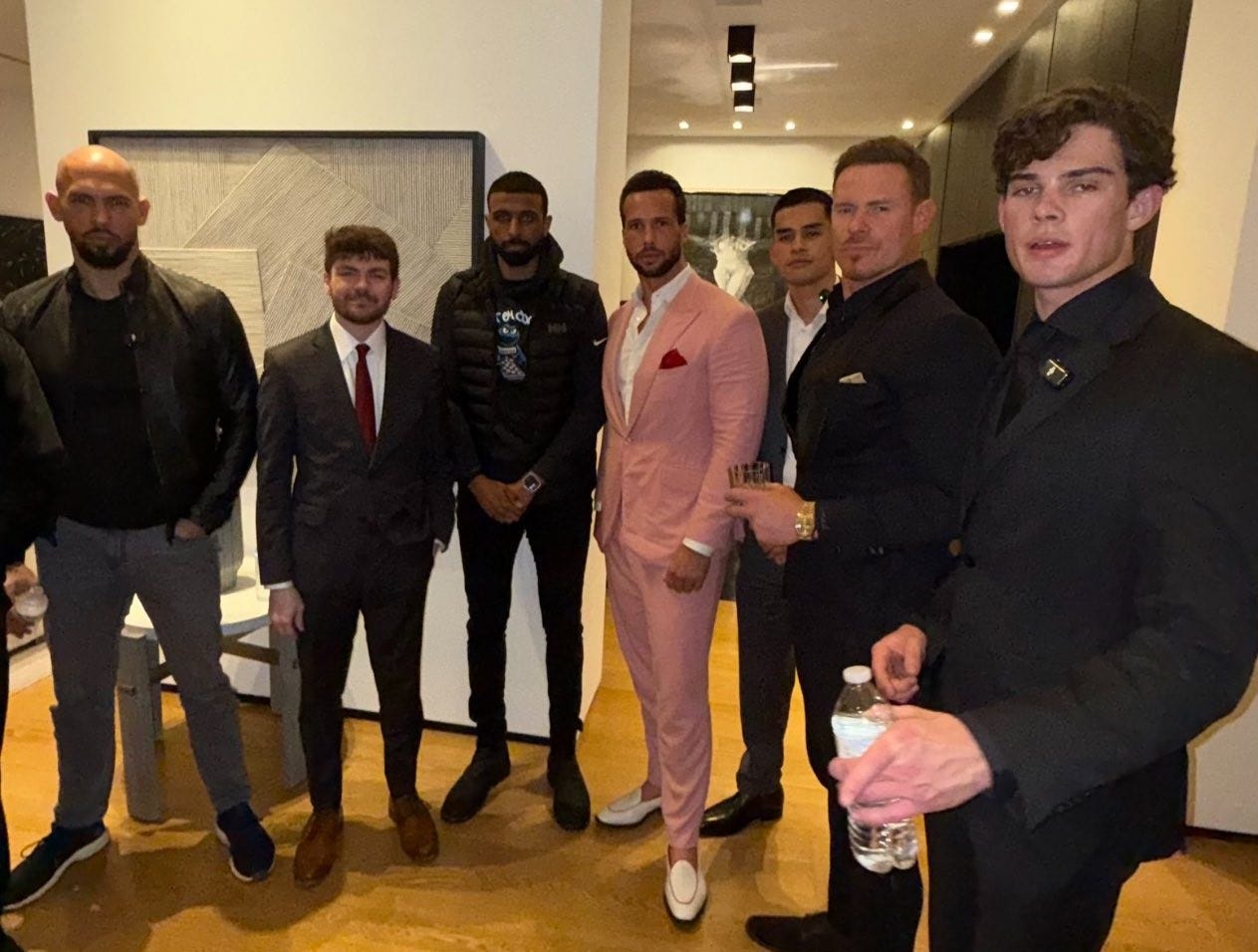
Right now, there are viral videos going around of Andrew Tate, Myron Gaines, Nick Fuentes, Clavicular, Sneako, and some hangers-on partying it up in Miami. It’s just manosphere #squadgoals. Tate must be the Taylor Swift. Fuentes is the Lena Dunham. The rest I’m not as sure about. That’s what a lot of these online gender wars boils down to: men and women fighting to carve out a space where their perspectives matter and where people like them get to be stars.
These past few months, I’ve done a bunch of literary readings, which are interesting events because they bring performance and proximity to an endeavour that can often feel distant. As a writer, for the first time, you get to experience the thrill of seeing in-person that people are taking in your words.
Some of the readings are relatively straight-forward in that they’re hosted by publications that have published my writings, so I’m supposed to read passages from whatever essay of mine they’ve published. But other readings have had fewer guidelines and for them, I’ve mostly written pieces specially for that event. In all but one of those readings, I’ve read something non-fiction and personal.
With this much freedom, I’ve started to think more about what I’m seeking to accomplish with these writings. Am I presenting myself as a person? Am I trying to sell a writerly persona? Am I seeking to, first and foremost, entertain? And if so, am I writing material that’s too different from what I usually write because people probably don’t want to listen to what amounts to a narrated essay? Should I publish these pieces I’ve written specifically for readings? But isn’t there something nice about composing something as a one-off thing that’ll only be heard by a small audience?
I’m also becoming wary of playing to the audience too much. For instance, a couple of my readings have centered on dating stories because they’re bound to be crowd-pleasers. But should I try reading something more challenging next time? I don’t want to devolve into a half-baked comedian (as opposed to my friend L Roch, a former social scientist turned funny stand-up comedian thanks to sitcom-like circumstances2) who becomes more and more scared of writing anything that’ll jeopardize my standing in my social circle.
Attention can be directed positively, though. The post-Christmas/NYE deadzone may be depressing, but I’ve come to appreciate it (provided you had a socially fulfilling holiday season beforehand). Everyone’s too sick or too out-of-town or too dry-Januarying to go out, or at least that’s the pervasive feeling. So you feel zero qualms about staying in on a weekend night to watch 3 episodes of Mad Men.
Speaking of which, my friend Trevor and I watched Last Year at Marienbad this past weekend. I’d suggested it because Trevor had previously referenced a series of Calvin Klein ads in the 90s that paid homage to this movie. I’d already watched Hiroshima Mon Amour, so I knew of Alain Resnais, but I’d never heard of Last Year at Marienbad before. My verdict? Gorgeous movie, but confusing, so I need to watch it again, especially since I fell asleep for about five minutes in the middle.
I thought about how I came to know of Last Year at Marienbad through the context of a commercial. In Mad Men, we see artists and businesspeople working symbiotically with each other and in doing so, there is widespread societal buy-in regarding the value of art, even if from different angles. But what happens when that link is severed? It’s become trendy to romanticize the industrial titans of the past as at least culturally superior to the tech boors of today, but there is a reasonable basis for doing so when that previously mentioned symbiotic relationship is replaced by something like AI. Art no longer becomes useful to commerce, which will no longer celebrate and preserve it. In fact, commerce’s simmering contempt for art—or to be more precise, artists—will encounter no resistance.
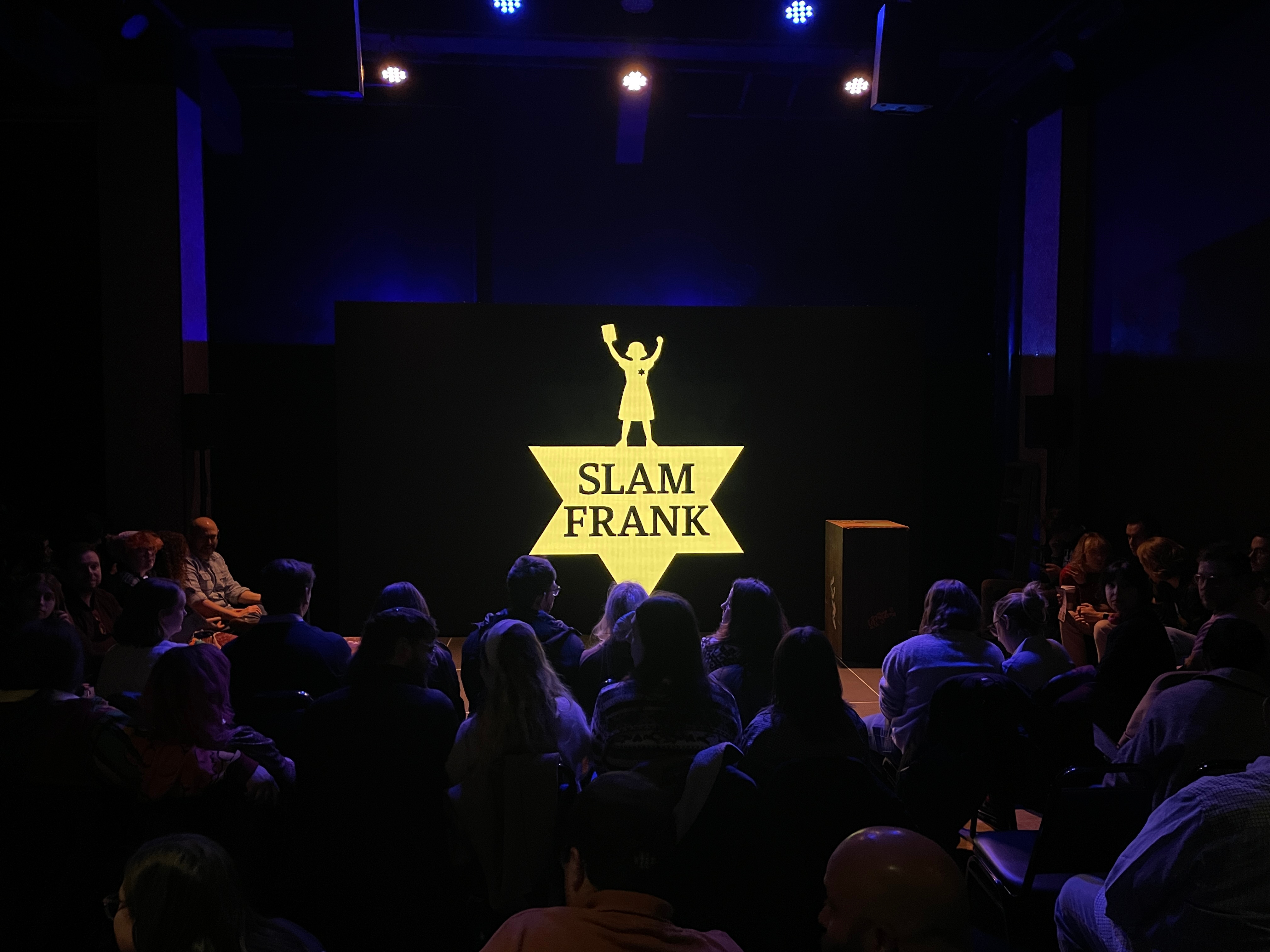
That’s why attending live cultural events is so important, from literary readings3 to concerts to theatre. A few weeks ago, I saw Slam Frank on closing night. It’s a satirical musical (written by Joel Sinensky and composed by Andrew Fox) that infuses extreme 2010s-era progressive identitarian culture into the Anne Frank story. While I wasn’t too blown away by the first half (the problem with making fun of maximal woke culture is that it’s already ridiculous enough as it is), the second half did impress me with how far it was willing to go in some very taboo areas (the show will run again soon, so I will remain vague so I don’t spoil it). At the afterparty, I learned from those involved in the show about how they were attacked by a rainbow coalition of determined detractors, from social justice types to Zionists.
Another show I enjoyed was a production of Jean Cocteau’s one-act opera, La Voix Humaine (starring Jamila Drecker-Waxman and directed by Kira Weaver), which was put on at the Brooklyn Center for Theatre Research. At a time when being under 40 essentially means you’re a teenager in the eyes of the Lincoln Center, it’s laudable that an indie theatre with a young audience is putting on operas. I should also finally watch Cocteau’s Beauty and the Beast.
In his piece criticizing the media blitz behind Madeline Cash’s recent novel Lost Lambs, Freddie deBoer wrote that “[n]ever before have networking, patronage, nepotism, and plain old rank corruption played such an outsized role in determining who gets seen, published, optioned, streamed, featured, or taken seriously at all.”4 He’s right, but it’s also true that the ceiling is lower and the floor is higher. It is indeed a copout to acknowledge that something unfair is happening but to handwave it away because nothing matters anyway. But it’s also my experience that in this time of heightened insularity among the elite, my own writing has also become more widely read. I’m still on the margins, but the margins aren’t so lonely anymore.
What even is the elite mainstream these days? The likes of Delicious Tacos is defending Cash, apparent darling of the stuffy New York literary establishment.5 In a recent spat between Anika Jade Levy (who co-founded Forever Magazine with Cash) and Valerie Stivers, the mainstream also seemed to side more with Levy, at least partially on the basis that Stivers is a contributor for the right-wing publication Unherd.6 But Levy also has written for Unherd. And Forever rose out of the allegedly fascist Dimes Square scene that the elite media warned us so much about (yet was also clearly deeply envious of).
Last year at a Drift party, someone told me that the host magazine hated being identified with woke Brooklyn instead of anti-woke Manhattan. I’m ultimately an outsider to all this, so this could’ve all just been drunken hearsay. But, again as an outsider, I see all these prestigious literary publications as more or less the same substantively. Every few years, a new clique of elite college alumni get together to form a daring new magazine that ends up indistinguishable from those that came before and those that will come after. This was The New York Times on The New Inquiry back in 2011:7
It was the weekly meeting of The New Inquiry, a scrappy online journal and roving clubhouse that functions as an Intellectuals Anonymous of sorts for desperate members of the city’s literary underclass barred from the publishing establishment. Fueled by B.Y.O.B. bourbon, impressive degrees and the angst that comes with being young and unmoored, members spend their hours filling the air with talk of Edmund Wilson and poststructuralism.
Lately, they have been catching the eye of the literary elite, earning praise that sounds as extravagantly brainy as the thesis-like articles that The New Inquiry uploads every few days.
“They’re the precursor of this kind of synthesis of extrainstitutional intellectualism, native to the Internet, native to the city dweller,” said the novelist Jonathan Lethem, an early champion.
There’s nothing wrong with people wanting to do cool things with their friends, and the more literary outlets and the more viewpoints (even if they’re only marginally different from each other) and fun parties there are, the better. But let’s stop pretending this is about principles when it’s really about personalities.
There was a recent piece in The New Yorker about the now-defunct Sovereign House.8 Who cares about Sovereign House in late 2025? For some reason, The New Yorker circles do. Why? I suspect it’s because, deep down, they covet their intra-elite rivals’ lack of social restraint, which triggers their deepest insecurity that they’ve never shed their honour-roll roots and, consequently, they’ve somehow lost the mandate of cool to racists and (pseudo-)religious zealots.
It’s notable how in the final episode of I Love LA when the young and cool main characters return to NYC, they hang out not in Greenpoint as they would’ve done a decade or so ago, but in Dimes Square (I think they even have dinner at Le Dive). This explains the incessant obsession some people have over a figure like Dasha Nekrasova, like how they celebrated when she recently got dropped by her agency. Nekrasova is not a Hollywood star or even a notable character actress, and while Red Scare is a successful podcast, a comparable show like Call Her Daddy is much more popular. For someone this crowd repeatedly calls washed up and irrelevant, Nekrasova is treated like some hugely influential, even aspirational, figure. Because to them, she is.
The Saddest Man in Comedy Just Got Worse - Podcast Cringe | Youtube
Moving to New York and Other Improv-ments by L Roch | L Roch
Perhaps People Are Cynical About Success in the Creative Arts for a Reason by Freddie deBoer | Freddie deBoer
“In deeply funny news, Valerie Stivers sent a truly humiliating message to Anika Jade Levy, got casually dunked on for writing for Unherd - a right-wing grievance rag for the grossly short of talent - and immediately 180s, claiming to be a heroic crusader against review corruption” - @BadWritingTakes | Twitter
New York’s Literary Cubs by Alex Williams | The New York Times
The Party Politics of Sovereign House by Emma Green | The New Yorker
I did not know about these podcast snark channels until now. My decision to quit comedy becomes more validated with each passing year.
If you found Marienbad confusing you were doing it right — the essence of the film is the balancing on the edge of undecidability of what’s when, dream or memory or lie. Resnais would return to this mode later (including especially Providence) but the necessary “know of” would be Robbe-Grillet, who made it his life’s-work … see his own films Eden and After or La Belle Captive, or novels like In the Labyrinth or La Maison de Rendez-vous (TW: blatant French orientalism).