
Marty Supreme Being
'Marty Supreme,' 'Blue Moon,' and the unhappy pursuit of greatness

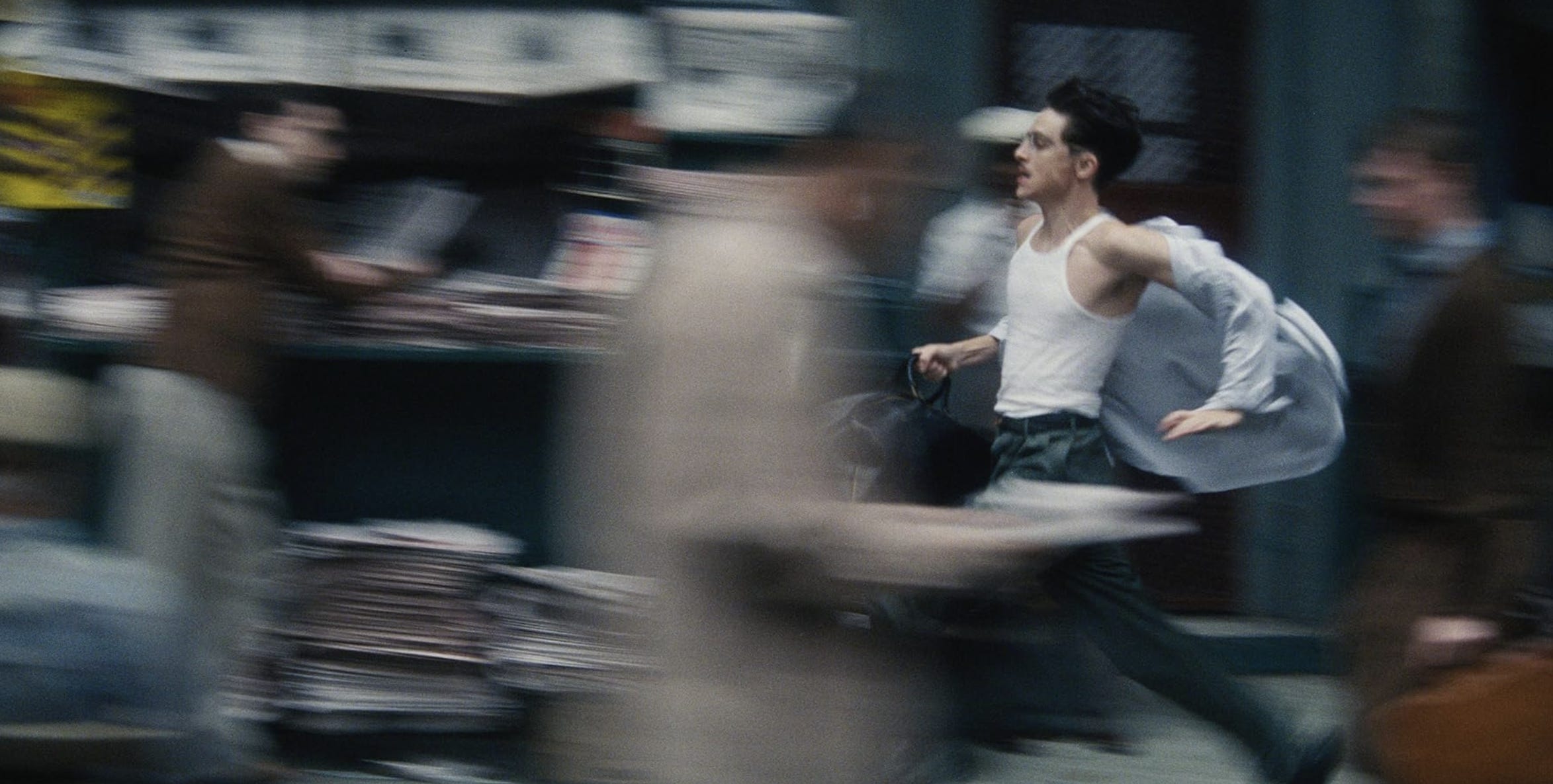
Until I watched Marty Supreme, I didn’t understand why there was a major film made about table tennis. It’s not as if all movies have to revolve around the most popular pursuits of their time. Does anyone want to watch Oscar bait about streamers? There’ve been recent movies or shows made about boxing, chess, jazz, and many other endeavours that can be generously classified as niche interests today. But at least those things once had their glory days and still hold onto some residual prestige. Table tennis, on the other hand, has always been (unfairly) considered a joke sport in the US.
But I began to understand after a critical scene in Marty Supreme, where Marty (Timothee Chalamet) tells his girlfriend Rachel (Odessa A’Zion) that he has a purpose, unlike her. He characterizes his crystal-clear destiny as both a blessing and a curse, and he uses it to justify why he can’t settle down with her even though she’s pregnant with their child. It’s an alienating little monologue, to say the least, and it exposes Marty’s delusional and self-aggrandizing mentality at that time.
It reminded me of the scene in Whiplash, where Andrew (Miles Teller) breaks up with Nicole (Melissa Benoist) because he thinks being in a relationship will be an obstacle in his pursuit to be the greatest jazz drummer of his generation.1 Andrew’s speech not far off from tone and substance from Marty’s. However, there’s still some lingering cultural cache with jazz. But ping pong?
I realized that’s the whole point of Marty Supreme (directed by Josh Safdie, without his brother Benny), though. The audience is not even given much explanation about why Marty is so fanatical about being a table tennis great. Is he a jock that failed out of every other sport except that one? Did a mentor instill a love of the game in him? But for the movie, the origin of his obsession doesn’t matter, and the more obscure the reason for his devotion is—and the more ridiculous-seeming the drive itself is—the clearer the point of the movie becomes: why pursue greatness? When the endeavour is cloaked with prestige or apparent altruism, there is the plausible explanation that your pursuit is for a greater good, with a nice little side benefit of fame and/or fortune. But what if it’s really just all about yourself and wanting confirmation that you’re better than everyone else?
I’ve seen discourse criticizing Marty as too selfish of a character, but such criticism rings hollow when there’s more palpable envy than moral disdain fueling those attacks. Selfishness is coveted as a supreme privilege in our culture, and the broadside against Marty is not why is he selfish, but why does he get to be selfish? The only acceptable narcissism is my narcissism!2 Whatever flaws Marty Supreme has (e.g. Marty becomes too much like Howard Ratner from Uncut Gems in the later stages of the movie), it is immensely entertaining and makes 2.5 hours fly by, and that is not an easy feat to pull off. It’s a great movie that’s well-worth watching.
The ending scene has Marty looking upon his newborn child. Marty is crying, and the most optimistic interpretation is that those are tears of joy. He’s just coming off finally winning a game against Endo (Koto Kawaguchi), his Japanese rival who dominated him in the final at the previous major tournament. And now, he is free to move on from his all-consuming and ultimately debilitating need to be the best.
But there’s also a darker way to read the scene. Marty is actually in despair. He had to abjectly humiliate himself just to get to Japan, only to learn he hadn’t registered in time for the tournament. His so-called win over Endo was meaningless, not only because you actually need to win 3 games to win a match, but it was also at a sales promo exhibition. He’s made powerful enemies at the international table tennis association. The sport itself might be passing him by (Marty Reisman, the real-life inspiration for the movie’s protagonist, favoured hardbats and could not adjust to the popularization of sponge rubber bats that allowed for more spin and trickier shots3). Marty never wanted to be a family man, and now he has to accept that his destiny was a mirage and what awaits him is a life of being miserable and causing misery to those around him. Or, as a compromise fate, maybe he and his kid can become a grifting duo like in Paper Moon.
As cynical as I may often be, I lean towards the sunnier version. Having watched Uncut Gems, Good Time, and Heaven Knows What, I like to think that a Safdie movie is due for a happy-ish ending. So Marty is at peace. Taking a game off of Endo is good enough, and he’s ready for the next phase of his life.
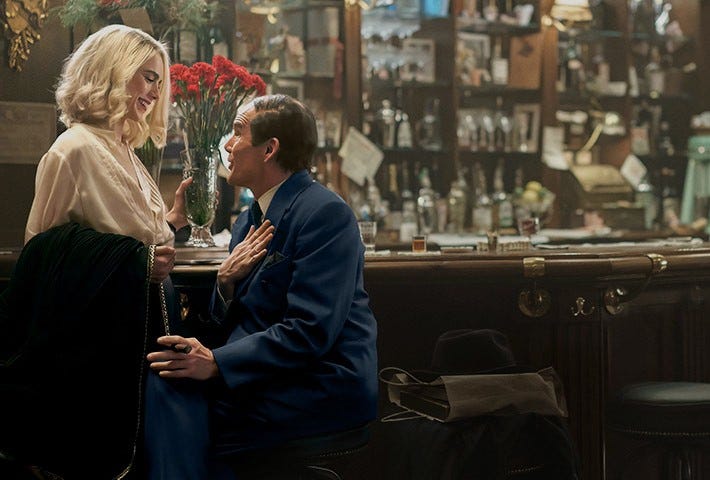
I also recently watched Blue Moon, a marvelous Richard Linklater movie starring Ethan Hawke (who almost carries the movie as a one-man show) as Lorenz Hart, a very accomplished lyricist who penned some of the most enduring of American standards like My Funny Valentine, Bewitched, Bothered and Bewildered, and Isn’t It Romantic? One of my favourite songs is Bill Evans’ rendition of My Romance,4 which was co-written by Hart, a delightful fact I only learned after the movie. You would think a musician who can take credit for such songs would be happy with his career. But Blue Moon is set on the night of the premiere of Rodgers & Hammerstein’s Oklahoma! Rodgers is Hart’s long-time collaborator. Together, they had some success, but with Oklahoma!, Rodgers’ career is about to reach new heights. Meanwhile, Hart is clearly on his way down, mainly due to alcoholism.
As I was watching Blue Moon, I just wanted yell at Hart to take a step outside of himself so he can see himself as I would. Granted, he’s not Richard Rodgers or Oscar Hammerstein, but that shouldn’t devalue his own accomplishments. Still, that’s easier said that done, and there are many times I’ve proven myself to be a hypocrite. Once, somebody told me with utmost sincerity that in the context of today’s functionally illiterate society, I qualified as a famous writer. I, of course, completely dismissed that remark. Have I written my equivalent of My Funny Valentine? No. But it’s now become a common experience for me to go a literary event and have people approach me to tell me about a piece I once wrote. That’s not nothing. That’s actually a very major something.
It’s strongly suggested in the movie that Hart is a closeted gay man, though Hart insists that he sees beauty wherever he finds it. One target of his objection is Elizabeth (Margaret Qualley), a college student and socialite who has theatrical ambitions. For all the nepo baby attacks against her, at least Qualley is luminescent in this role, far more than her mother Andie MacDowell in the extremely overrated Four Weddings and a Funeral.
Guessing whether Hart has platonic or romantic feelings for her is besides the point. To him, she represents someone who’s firmly in a special class of people: beautiful, wealthy, and as Hart wistfully says to Rodgers:
“I’m in love with her. But everybody’s in love with her.”
He so desperately wants to be wanted by someone that special, that great, and if the highest expression of that desire is heterosexual (particularly in the 1940s), then he’ll yearn for that.

I have many thoughts on Jacob Savage’s “The Lost Generation”5 essay that I’ll discuss in a later piece, but as with his essay on missing white male Millennial writers, I find it interesting that he focuses so much on Millennial white men as opposed to Gen Z white men, who presumably have it even worse. One reason could be that Gen Z guys opted out from the get-go and are less disillusioned. That sets up white Millennial men as the Lorenz Harts. It’s a generation that wanted to be truly great—especially as our culture has turned even more hyper-individualistic and attention-seeking—and its chance to be so is nearly over, if not already so. The Millennial Midlife Crisis is in full swing.
These movies have also made me think about how I’ve lived my life selfishly to this point. I’m using the term “selfish” in an objective sense in that I don’t have any dependents and I’ve purposefully minimized my responsibilities to others to leave enough time and space to pursue writing. But I’ve been writing for quite a while now. The last couple of years have been dedicated to a major writing project with which I’m so close to finishing now.
What’s next? With the new year just a couple nights away, it’s an appropriate time to look ahead to 2026, which I think will be a year of major personal change. As usual, my brother and I hosted Thanksgiving and Christmas dinners at our place. This time, however, I was aware that these holiday gatherings were likely to be the last ones we have at our apartment. If so, I was eager to sign off on a high note. Fortunately, both dinner parties were two of the best we’ve ever thrown.
Maybe I’ll start living more for others soon (paradoxically, by living solo again). Once my brother and I move out and off to our own places, it will be the end of an era, one that I expect to be fondly telling my own children about one day. “Did you know your uncle and I used to be roomies in the big city when we were younger?” Who knows where I’ll be living then. I keep reminding myself to not take these remaining moments together for granted, but I also don’t want to drown in sentimentality. The future is brighter! But I know I’ll regret not letting myself drown a little.
Happy new year!
Whiplash - Break Up clip by Universal Pictures International Netherlands | Youtube
The real ping pong champion — and hustler — who inspired ‘Marty Supreme’ by Elizabeth Blair | NPR
Bill Evans Trio - My Romance (Official Visualizer) by Bill Evans | Youtube
The Lost Generation by Jacob Savage | Compact
On the selfishness aspect, I've come to the conclusion that accomplishment for the sake of acclaim or approval from others (family, friends, hordes of strangers) can be, in a rather paradoxical and perverse way, quite "anti-selfish" (to distinguish from "unselfish" or "selfless"). To subordinate one's own goals -- or to even lose sight of them altogether or not have properly formulated any in the first place -- to please or impress others...what is that, if not profoundly antithetical to one's own *self-actualization*?
I think in some ways, the sciences and the performing arts and sports are kinder to the soul than the (arts-) arts: one can define objective measures of success, which one achieves independent of others' recognition. There are open questions in the sciences, and frontiers that make notions of a "breakthrough" quite sensibly defined. Novak Djokovic collects Grand Slams regardless of how anyone feels about it. Yuzuru Hanyu sought, instead of a gold 3-peat at the Olympics (something that arguably would have made him even more a hero in Japan), his white whale of a quad axel -- a jump he either would or wouldn't land when it counted most, and something to which he hitched an immense amount of personal meaning. But the arts are different; critics and tastemakers can wholesale define success and failure in ways that are impossible in those other domains. Good luck to all of y'all pursuing success in that world, I guess.
Dying to see both of these movies. I could tell Marty had Whiplash vibes from the very first trailer.