
Start Asian Hate
What's behind the recent disdain for Asian American culture?

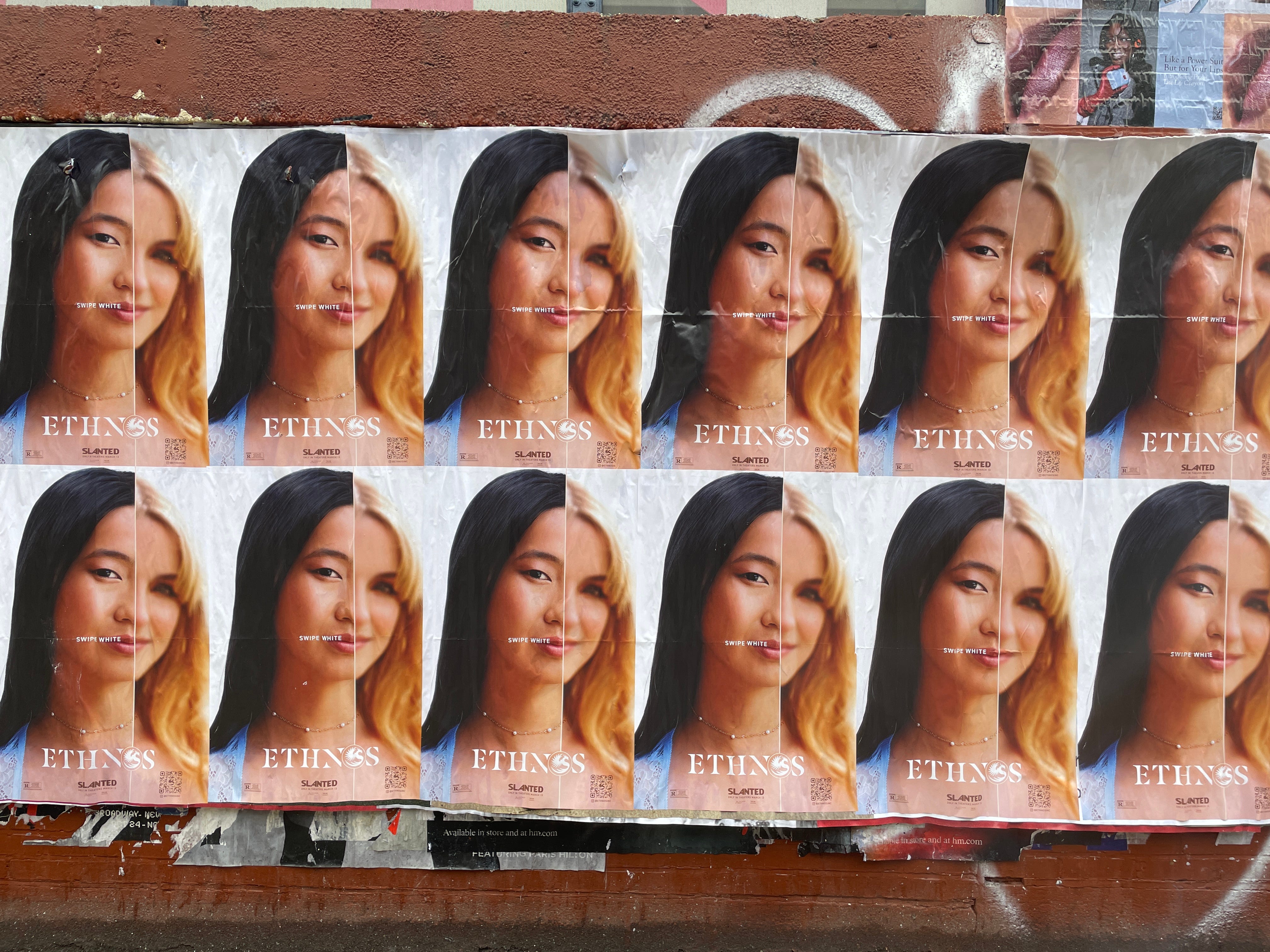
The thing I’ve come to dislike the most about mainstream Asian American culture is this suffocating miasma of nervous energy I feel within it. It’s the nervousness of a people that are constantly looking over our shoulders. If you’ve ever wondered why so many Asian American go berserk over food, it’s because it’s one of the few avenues where we feel permitted enough to ever bond or vent about anything. Our collective pent-up pride and rage are channeled into a bowl of noodles.
So when I heard about this new movie called Slanted, I was cautiously optimistic. The premise was refreshingly blunt: an Asian American girl hates being Asian so much that she gets a radical transracial procedure to become a white girl. When Get Out first came out, my Asian American friends and I joked that the Asian American equivalent would be called Get In. Now, it was happening!
Written and directed by Amy Wang, Slanted tells the story of Joan Huang (played by Shirley Chen), a Chinese American teenager in an Anytown, USA suburb sometime in the pre-Trump 2010s. She has a loving father and mother (played by Fang Du and Vivian Wu, respectively), but as working-class immigrants, they do not have the time or cultural fluency to help her feel at home in America. When Joan’s attempts to become part of the popular white clique only result in failure and humiliation, she opts to undergo a drastic procedure that will allow her to become the white girl she’s always dreamed of being (played by McKenna Grace).
For Slanted to be fully appreciated, context is everything. While it’s common for Asian Americans to be called out in progressive circles for white adjacency—because we’re not politically active enough or we worship the Ivy League too much or we name our children Edward and Vivian too much—that scrutiny is usually softened when it comes to 2nd generation Asian American women who have successfully assimilated not just economically and culturally into white American society, but socially as well. This results in an untenable logic: the low-income Chinatown auntie who is only half-fluent in English and dreams of sending her kids to a public magnet school is guilty of white-adjacency, but the American-born Stanford-educated Asian woman who works at The New York Times and has a trust-fund white husband is not.
It’s telling that the most mainstream scrutiny of Asian and white romantic relationships is the 2023 movie Shortcomings. Directed by Randall Park, the film is based on an Adrian Tomine graphic novel about a young Asian American man who is sexually obsessed with white women. While such men exist, it is much more common with the genders reversed. There’s a reason that “Oxford Study,” a short-hand term to describe the noticeable preference that many Asian women have for white men, has become a popular meme. Some try to duck the issue by saying that the underlying study that the Oxford Study is named after doesn’t actually exist. But that avoids the actual substantive question: are white male/Asian female (WMAF) couples noticeably more common than any other interracial pairing, and if so, why? Some also try to blame the term’s popularity on bitter Asian American male losers, as if they have the clout to start trends like this. To the extent that any examination is permitted, it has usually been in the form of gently self-effacing stand-up comedy or sadgirl literature that removes any agency from the Asian American author/protagonist.
In contrast, Slanted does not shy away from the uncomfortable notion that an Asian American girl might want to be a white girl so badly that she’s willing to go to extreme measures to achieve it. Wang has said the film has major autographical elements, so even before I watched the movie, I had to admire her willingness to portray such an unflattering self-image. Nobody likes to admit that they wish they were someone else. But white-girl envy is clearly real, as can be seen from the many essays, often on Substack itself, by women of colour regarding what they feel is the undeservedly high amount of adulation that white women receive.
Still, good ideas are plentiful while good execution is rare. Slanted’s unsubtle plot also ran the risk of being too clumsy, so I had low expectations. But I was pleasantly surprised and I found myself invested in Joan. The key is that she’s not written as a lofty-minded character. She’s not escaping the clutches of her overbearing parents, who are actually portrayed as supportive and loving, especially her softie of a father. She’s not bravely ditching a misogynistic Confucian culture. There’s no concoction of a mean Asian clique that rejects her first, thus giving her no choice but to seek social acceptance elsewhere.
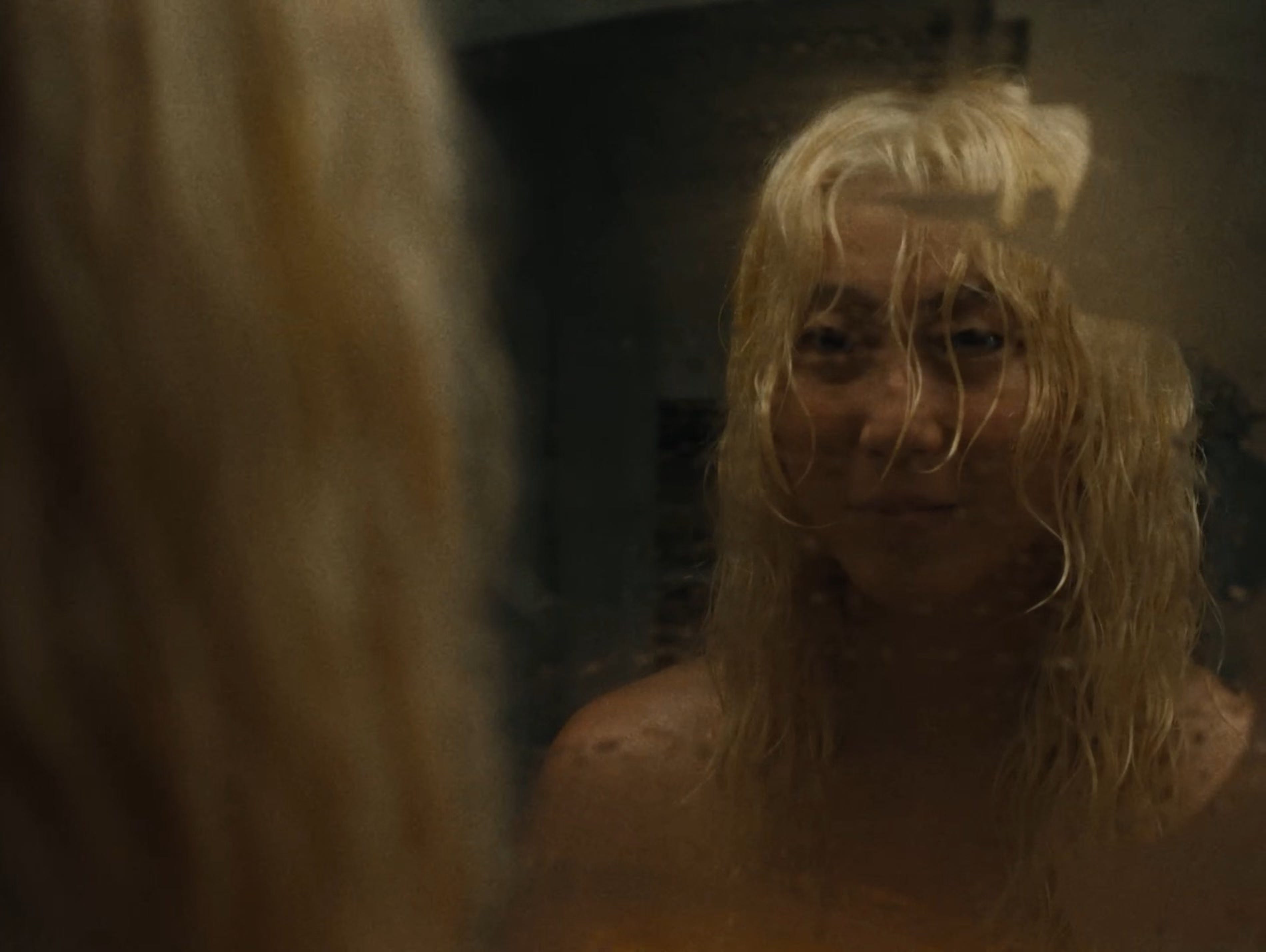
No, Joan just wants to be cool, popular, and prom queen. But that’s exactly what makes Joan sympathetic (credit to Chen’s performance too). So she gives in easily to peer pressure. Don’t we all, at least at some point in our lives? I’ve seen some negative reviews that proclaim how pretty Joan is and how stupid it is that she would rather be white than Asian. Yes, she’s attractive, but the whole point is that she can’t see that. She likely has boys crushing on her too, but they’re probably dorky white boys with yellow fever or Asian American boys. She doesn’t want their low-value attention. And she has a very devoted best friend, Brindha (played by Maitreyi Ramakrishan), so she’s not friendless. But Brindha isn’t popular enough for her.
Critically, Joan has agency. There is a touching scene where Joan tricks her mother into signing the parental consent form that will let Joan change her race. Her trusting mother doesn’t even look at the form, believing Joan’s claim that it’s for a field trip. After the form is signed, Joan fights back tears, knowing that this will be the last time her parents see her as they’ve known her. Obviously, this is a terrible decision. But it is a decision nevertheless, which makes Joan more interesting than if she just moped around.
However, decisions mean agency which means responsibility, and many Asian American artists (especially in contemporary literature) would rather abdicate agency in order to forego responsibility. The Asian Americans who get to tell Asian American narratives are often the ones who’ve succeeded the most in assimilating into elite non-Asian circles, and they are loath to acknowledge what they’ve done to get there. Everything just happened to them! And they had no choice but to not resist! So they portray themselves as child-like: you wouldn’t get mad at baby, would you?
Some may castigate Joan as a sellout and an embarrassment to her people. But her portrayal is far more respectful to Asian Americans as a whole than if the movie tried to win sympathy for her by throwing some segment of her community under the bus. Slanted says, “It’s not you. It’s me.” But in a sincere way. It’s a move that breaks free from the habitual face-saving that 2nd generation Asian Americans like to imagine that only our immigrant parents ever engage in. And Slanted is all the stronger for doing so. There’s much more artistic merit in Sheena Patel’s novel I’m A Fan or Jenny Zhang’s essay Far Away From Me1—both of which discuss the yearning to be white with brutal honesty—than in something like R.F. Kuang’s novel Yellowface, in which Kuang launders her resentment of white women by creating a clownish white female protagonist who’s envious of a more talented and beautiful woman who’s a thinly veiled stand-in for Kuang herself.2
Spoilers below in next 3 paragraphs
Slanted has its flaws, such as occasional heavy-handedness that undermines the satire. For instance, in the beginning, you see stores with names like “Freedom Café” and “AR-15 Foods.” Are we in deep red country? I don’t think so, because Wang has said the movie is autobiographical and she grew up in the suburbs of Sydney, Australia. So these elements come off as lazy jokes. Two of the more heated exchanges between Joan and her parents are, while heartfelt, too articulate and on-the-nose. In the first 5 minutes, there’s already a pulled-eye gesture from Joan’s classmate and a stinky lunch incident. Even the title itself seems parodically cliched since we already have The Slanted Screen and that band, The Slants. Will the sequel be called Slanted 2: Throwing Off The Yolk?
The ending is also too open-ended. Joan’s body starts to aggressively fight back against her racial transformation. This, combined with her guilt, leads her to tear away her new face. Does she survive this process? If so, is she disfigured for life? Or does she get a merciful mulligan? I suspect the ending is ambiguous because nobody knows what the next step is for the Joan Huangs of America. Do they move to Asia in a Chinamaxxing world? Do they stay the course in their quests to fit in? Do they split the difference and become proud Asians, but only to the extent that it helps them gain relevance in their diverse social circles?
I suspect Wang herself doesn’t know, so this is how she signs off. But she’s done enough and a movie like Slanted is an encouraging sign that we’re entering a more honest era of Asian American culture.
Everyone hates mainstream Asian American culture right now. Everything Everywhere All At Once not only won too much of everything everywhere all at once, but it also did so very Millennially, complete with weepy parental apologies and Reddit humour. The 2nd generation Asian American summit was reached, and the long-standing fight for media representation lost whatever shield of pioneering idealism it once enjoyed.
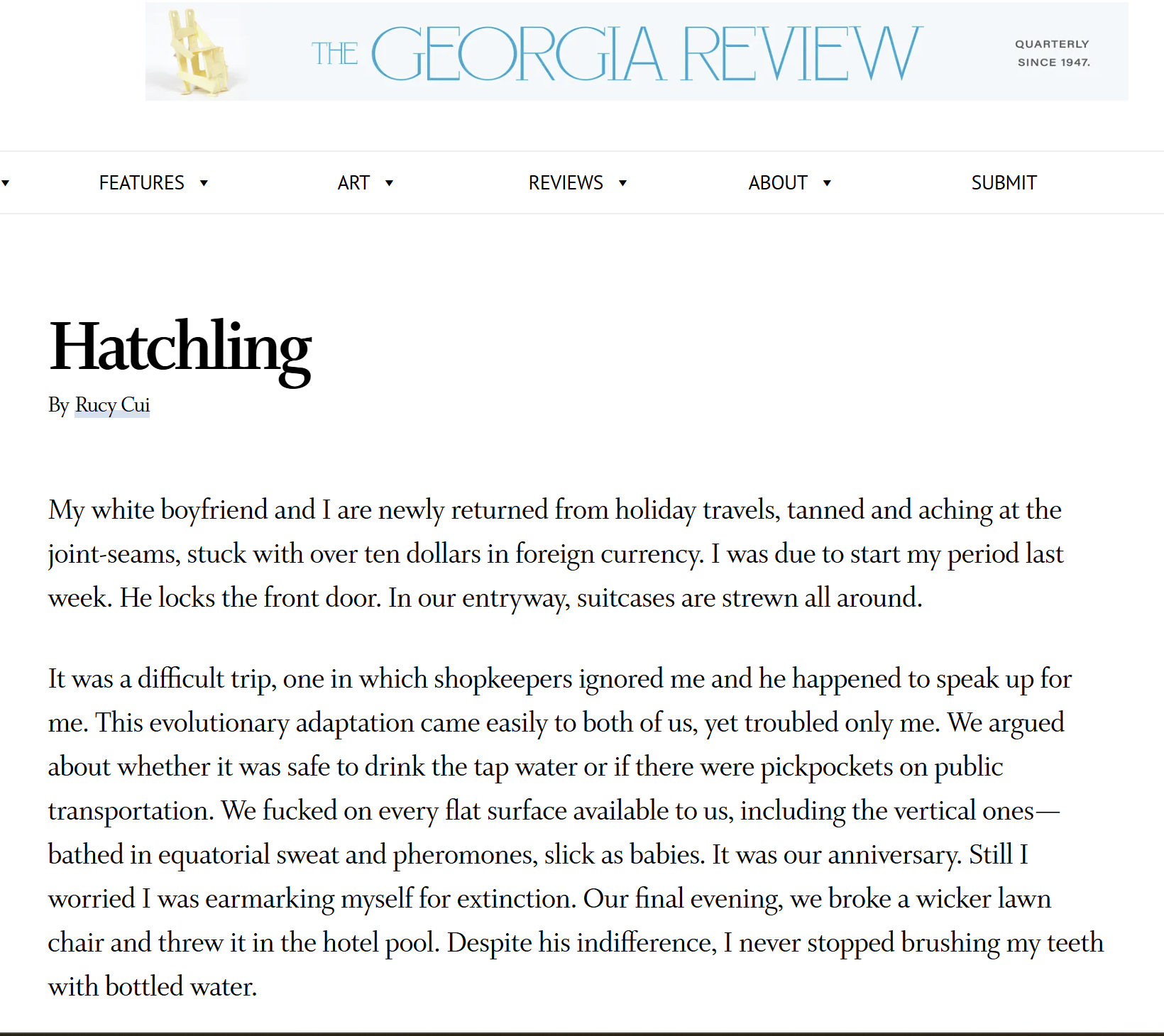
In late February, there was online fervour over a new short story published in The Georgia Review entitled “Hatchling” by Rucy Cui.3 For anyone familiar with contemporary Asian American literary fiction, “Hatchling” is nothing out of the ordinary. All the familiar tropes are there: a straight Asian American female protagonist, memories of weird and/or abusive parents, interpersonal annoyances involving a white boyfriend, on-the-nose incidents of racism, and a pervasive mood of resigned melancholy. If you asked a squad of 2010s Asian American literary fiction connoisseurs to identify a short story or novel that contains these elements, each could come up with a different but correct answer. Some may call this type of writing diaristic, but I imagine reading someone’s diary would be a riveting experience.
But what was extraordinary about “Hatchling” was the widespread mockery the story received. In the past, only a few Asian American men would’ve complained and then be dismissed as misogynists. However this time, everyone was expressing the same exasperation over why this cliched and boring type of story kept being foisted on us again and again and again. People have eyes and ears, and the truth will be said aloud eventually.
As someone who’d gotten into a lot of trouble in the 2010s for criticizing narratives like “Hatchling,” I found this whole episode extremely cathartic. Back in 2022, Current Affairs published my essay, “Asian American Psycho,”4 which attacked Asian American culture for being capable of only producing stories like “Hatchling.” Based on a previous experience, I was half-expecting the magazine to apologize for, or even pull, my piece due to public outcry. When that didn’t happen, I knew that something had changed.
Yet all the vindication I feel has been coupled with exhaustion. Over the past couple of years, I’ve been seeing more and more memes making fun of Asian American culture, to the point where such ridicule is getting boring. Netflix just announced a new show called Dang! about young Asian Americans, and the default social media response was a collective eyeroll at the anticipated diasporic whining. It’s starting to feel like the backlash against Ocean Vuong, where the validity of the criticism became overshadowed by the opportunistic piling-on. Hey, where were you guys a few years ago, when it was much riskier to make these same critiques? Do you genuinely want to pave the way for better art or do you just like being the bully, as opposed to the bullied, for once?
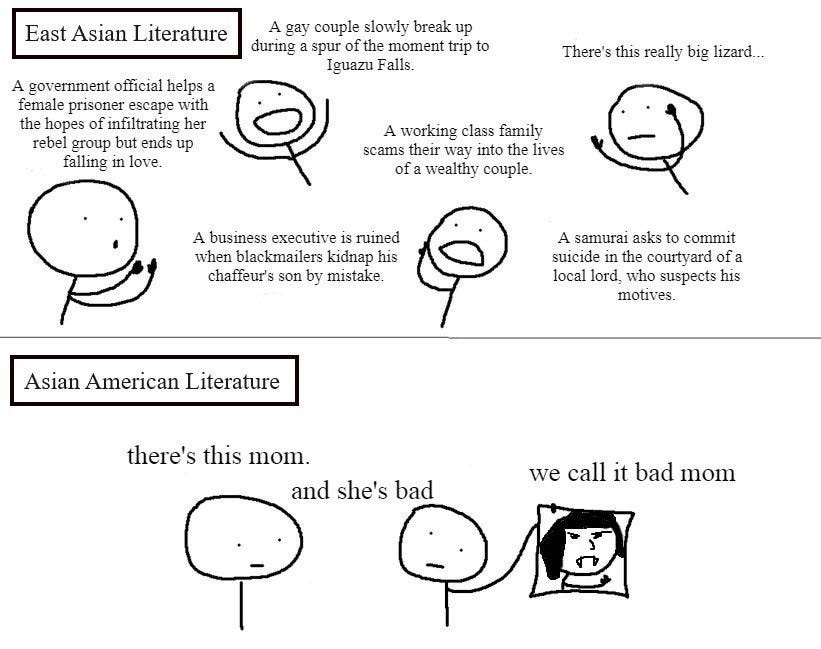
I also felt some sympathy for Cui. For all I know, she and I might agree on a lot of things about literature and get along very well as friends. I see her as the unfortunate youngest child in a family, doing exactly what her older sisters did to great praise, only to be reprimanded when it was her turn. “Hatchling” would’ve been celebrated if it’d been published even just 5 years ago. If I were her, I’d feel shortchanged that the rules had been altered in the middle of the game, and I’d secretly resent the likes of Weike Wang, Rachel Khong, and R.O. Kwon for having so dominated the Millennial Asian American literary landscape that they left nothing for me but ridicule in following in their footsteps.
The public reaction to “Hatchling” also gave me license to reflect more on my own resentments, especially those that lingered from the 2010s. It can become too easy to savour bitterness.
Last November, I attended the opening gala of the 26th San Diego Asian Film Festival as part of the jury. I was honoured to be there, but I still couldn’t help but fear the onslaught of that nervous energy that I found so endemic to these Asian American gatherings, especially in creative circles full of earnest self-described storytellers with their convictions that only if there’d been a Gilmore Girls centered on Lane Kim or a rom-com starring Bruce Lee, then so many Asian American lives could’ve been saved. But no anger, remember! Smiles, everyone!
But I was there because of my writings, not in spite of them. The organizers had read “Asian American Psycho” and liked it so much that they’d invited me to be one of three jurors. I was in friendly, not hostile, territory. Yet there I was clinging to this fossilized image I had of myself as this unwanted and even repulsive outsider when, in fact, I was now much closer to the inside than not.
I had a great time at the festival, though I was only there for the gala. It was a pleasure to be a juror and enjoy advance screenings of many excellent movies and shorts, especially the grand jury prize winner, Fucktoys (a hilariously campy film in which Annapurna Sriram—who also wrote and directed the movie—plays a sex worker on a quest to lift a curse on herself5).
After San Diego, I took a train up to LA to visit friends. The last time I was there was in the fall of 2018, a tumultuous time for me. That year, I’d finally gotten published in a magazine, Electric Literature. Or so I thought.
Unfortunately for me, 2018 was also the year that Celeste Ng had gotten embroiled in a controversy over a couple of tweets she’d made in the past saying, apropos of nothing, that she didn’t find Asian men attractive because we reminded her of her cousins. This would’ve just been forgotten as a weirdo remark if it weren’t something that Asian American men often heard from Asian American women. Many were riled up by the fact that such a public and outwardly progressive Asian American woman felt so comfortable saying that out loud and without any pushback, and I wrote something to address the whole situation.6
I’m guessing it was this piece (and others like the one criticizing Jenny Han’s To All The Boys I’ve Loved Before for its creepy racial politics7) that put a target on my back. I’d written those pieces under a pseudonym, but the Electric Literature piece had been submitted under my real name. My editor loved my piece, which addressed the absence of Asian American male perspectives in American culture and how it was up to Asian American men ourselves to fix that. But shortly after publication, someone must’ve alerted the magazine about the other things I’d written and how I was problematic. So Electric Literature slapped the note below on top of my piece.
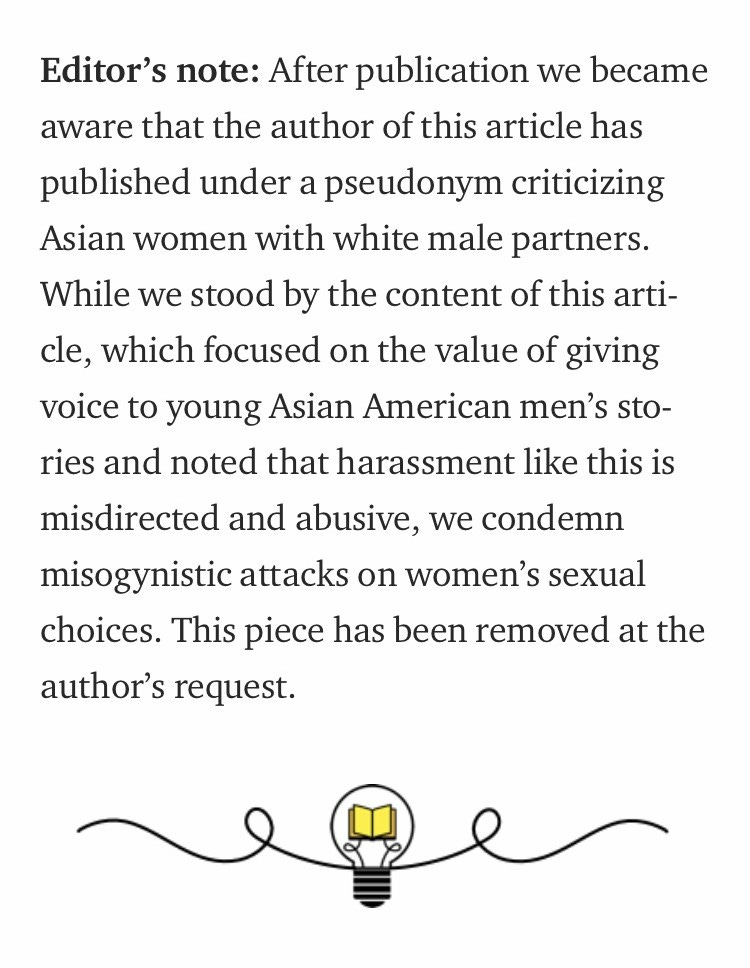
Immediately, I requested that they take down the essay and keep their payment. My editor said that she never would’ve accepted the piece if she’d known who I was. They deleted the text of the essay, but the editor’s note remained. In fact, it was one of the top hits when you searched my name. I asked Electric Literature to please delete the web page altogether. They ignored me. So I consulted a lawyer, who said all he could do was write a cease-and-desist letter, but it likely wouldn’t have any effect and it would also cost around $1200. Naturally, I declined. My friends advised me to just go to Philly that weekend as I’d originally planned, and that everything would work out in the end. I took their advice and went to a CHVRCHES show in Philly with my friend, where I did molly for the first time and had a blast. That’s still my favourite concert.
I’ll aways be grateful to Yowei Shaw (the host of the NPR podcast Invisibilia at the time) for meeting up with me that weekend in Philly. She herself had been the target of online attacks earlier in 2018 for going to an Asian American women’s subreddit and asking for stories she could use as background research in an upcoming episode about WMAF relationships. For even daring to discuss the topic, she was heavily censured for internalized misogyny and racism by the same crowd that had gone after me. I admired her because she’d chosen to produce that episode even though the subject matter made her personally uncomfortable. We drank coffee out on the leafy sidewalks of West Philly and we commiserated over the insanity of it all. It meant so much when she said there was nothing objectionable about what I’d said.
In The Loneliest Americans by Jay Caspian Kang, there is a chapter in which he meets up with an infamous (at least in Asian American circles) online figure named Disciple888, who posted extensively on Reddit about anti-Asian racism (mainly about the humiliating desexualization of Asian men) and Western imperialism in Asia. In the early/mid 2010s, I’d read many of Disciple888’s posts and while I thought he often went too far with his conspiracy theories and harsh condemnations of Asian women he didn’t like, I did also admire how well-read and charismatic he was, especially when compared to your typical Asian American guy sulking online about media representation and dating.
So when I was in LA in 2018, I just had to know what he was like in real life. We had dinner in Ktown and he even let me crash at his place for the night. The next day, he tweeted out a photo of us with a caption proclaiming that all the traitors would be rounded up and shot when the revolution came. I asked him if he could delete that inflammatory caption. He called me a coward. I never saw or spoke to him again.
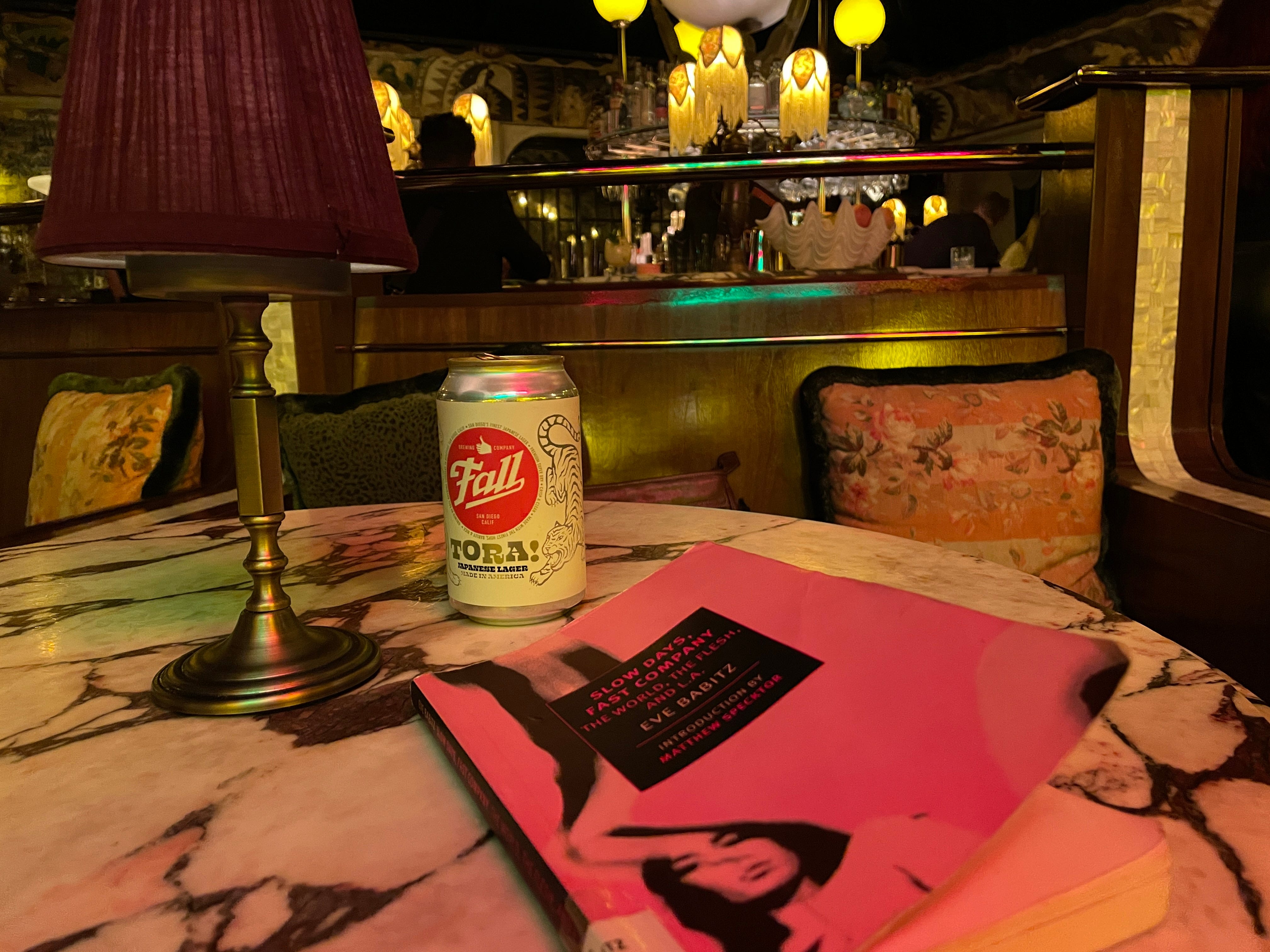
As I walked around LA last year, it struck me that a whole 7 years had passed since my last visit, and how much things had changed. Now, Asian American movie producers were reading and agreeing with what I’d written. Back in 2018, I’d walked around Rittenhouse Square in Philly in a dazed state, wondering if my literary dreams had been dashed because no matter what we claim, we never leave high school and it was all a popularity contest and guys like me would be outcasts forever. But there I was in a coffee shop in LA, writing a new piece for a reading I was to do soon after I returned to NYC.
The Asian American online wars of the 2010s now seem adorably quaint. Looking back, I can see that those fights were the long-suppressed outbursts of Asian American Gen Xers and Millennials, the first big batch of us who’d been born in America but had no guidance from anyone who came before us, because they didn’t exist. We’d had to figure out a lot of things ourselves. So of course, we’d all be a little hysterical.
I often wonder what all the people who’d watchdogged me back then are doing now. It seems that I’ve outlasted most of them. Maybe they’re doing their own thing and thriving. I recently looked up someone who used to greatly annoy me on Twitter. To my embarrassment, I learned that she is much younger than I thought. Was that whom I’d built up in my head as this malevolent force?
A little while ago, I saw a tweet that wistfully upheld a 2004 Goo Goo Dolls concert moment as the peak of American culture. There stands Johnny Rzeznik, about to sing the band’s biggest hit to thousands of adoring phone-free subjects just living in their gloriously shared monocultural moment. There is torrential rainfall, but the Goo Goo Dolls don’t care and they sing Iris with their hearts out. Never would America experience something like that again.
I love the Goo Goo Dolls, and having come of age in the late 90s and 2000s, I will always have some nostalgia for that time period when America was at its sunniest. But I also can’t idealize that era, knowing that it caused a generation of Asian Americans to yearn for nothing more than acceptance into a diverse society that would have room for us, but only some. And many of us were willing to sacrifice almost everything to get in. If we are indeed hitting an inflection point in Asian American culture, it’s because Millennial Asian American influence is fading. Good riddance.
It’s true that we need to move on from these perpetually adolescent narratives. We don’t need a decade’s worth of Slanted derivatives. But we do need an artistic stretch where we create works to counterbalance what has come before us.
There’s this dorky term, “narrative plentitude,” that came about during the height of the media representation era. It means that a marginalized group gets to have more than just one narrative about itself. A noble concept, but much easier said than done. If “Hatchling” and its ilk could willingly co-exist with other narratives, especially competing ones, then that’d be one thing. But one of the key lessons I’ve learned is that the Asian Americans who most want me to shut up about WMAF issues are absolutely fixated on the topic themselves. It’s not that they want an embargo on the subject. Rather, they just want a monopoly on what they see as a narrative gold mine, the precious thing that grants them relevance. The repulsive corollary is that, whether in cultural depictions or in real life, Asian women have no light of their own except what they reflect when they orbit white men.
In that case, my stance is that if you get to talk about it, then we all get to talk about it. Like, actually talk about it. In fact, I’ve just finished this novel that takes all this stuff we’ve been pussyfooting around for generations and just runs to the extremes with it. Let’s get it all out there. And then finally, let’s move on.
After all, how much more should I be writing and talking about these Asian American male concerns anyway? It’s always been a losing proposition for Asian guys: either we’re wrong and we’re just delusional whiners, or we’re right and prove that we are indeed the lowest men on the totem pole. I’m fully aware that writing about all this doesn’t make me look cool and dashing. But if I don’t talk about it, who will?
I’ve always felt about 5 or so years younger than my actual age. However, I’m finally starting to feel old these days. But in a good way, like I’ve earned my age through memorable experiences and not just the passage of time.
I’m now something of an elder statesman in my literary circle, and some have even said I’m a cult figure among the young Asian American men in it. A (micro) cult figure? I’ll take that. If I were forced into retirement right now with a career-ending injury, I’d take some solace in having achieved at least that much. But I’m not quite done yet. And I’m also optimistic by what I’ve been seeing lately. Asian America is finally growing up.
Far Away From Me by Jenny Zhang | Rookie
Yellowface-saving by me | Salieri Redemption
Asian American Psycho by me | Salieri Redemption
‘Fucktoys’ Teaser Trailer | Youtube
The Deeper Roots of the Celeste Ng Controversy by me | Plan A Magazine
‘To All The Boys I’ve Loved Before’ Has Creepy Racial Things Going On by me | Plan A Magazine
Lots of great insights here. There's this icky sense when I read Asian-American fiction (and consume AA media), especially when it's authored by Asian-American women, that it is pervaded by this obsession with social status. This manifests in two tracks: (1) within the protagonists themselves, who are obsessed with real and perceived racial slights, who aim to enter into romantic relationships with high-status (i.e. white) Americans, and (2) in the meta aspects of the narrative, which seem crafted to appeal to the politically correct tastes of culturally elite (i.e. white) Americans. 'Hatchling,' is not only a buzzword bingo for Asian-American tropes, it also has all these random signifiers of political correctness crammed in (the one black female employee at the protagonist's company is a "rock star," because of course it wouldn't be woke enough if she was just a normal human being)
This obsession with status partly has to do with the way that Asians fit into American society (esp. Asian women), and it's not completely invalid to write about social status if it's something that's on a writer's mind a lot, but, as I think you've said many times, obsessions like this lock Asian-American fiction into a very narrow, very confined narrative space. I don't want to exempt male Asian-American writers from this criticism. I think there are male writers out there who are doing the junior league version of 'Hatchling.'
Sadly, I don't see Asian-Americans escaping this trap. We let the lamest, most brittle, most weirdly status-obsessed kids run the show, and they have defined what Asian-American fiction is for the rest of the country
The problem with this film, as with so many of the films and books about which you write, is that they are just not very interesting on their own merits. It is the same themes and tropes that were already exhausted by the likes of Philip Roth and co, but decades down the line and even more watered down. No one is going to watch or read these works unless they are encountered on a syllabus or the watcher / reader is in the industry, so the only commercial or artistic imperative behind them is to please Teacher.